
Let’s Acknowledge Our True Value!
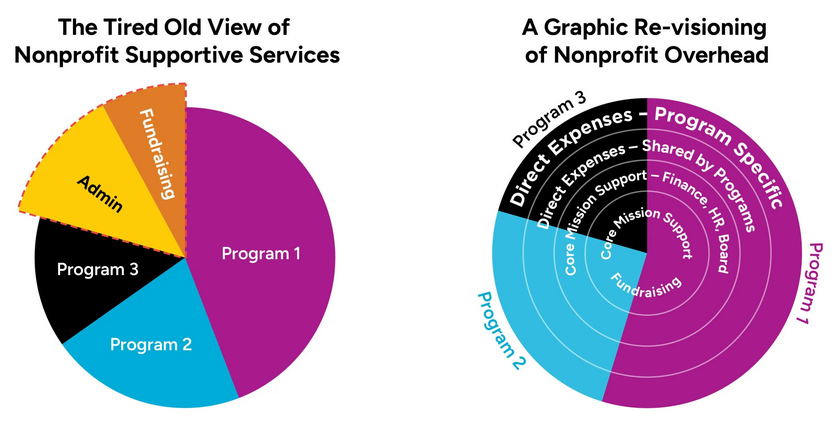
In 2016, I published a blog titled “A Graphic Revisioning of Nonprofit Overhead” on the Propel Nonprofits (then Nonprofits Assistance Fund) website. The article communicated the concept of true program costs in simple graphics that captured how the nonprofit sector was evolving its thinking about and communication of the importance of core mission support, the crucial administrative and infrastructure costs that are the foundation of any financially healthy organization. But today, ten years after I wrote that article, I have come to realize that true program costs are only the beginning of sustainable nonprofit finance. We must go further in our understanding of and how we communicate about what is truly needed for nonprofit organizations to thrive and deliver the societal transformation that our sector promises and our world so badly needs. We must go beyond simply declaring the full cost of our work. Now is the time to boldly calculate and state the true value of our programs. In a time when nonprofits are under intense scrutiny about our impact and use of funds, facing debilitating chaos in public funding, and enduring persistent inflation, we must continue to evolve from a true program cost perspective to a true program value mindset.
An Idea Born Out of a Nonprofit’s Internal Struggle
The catalyst for the 2016 article was a plea for help from the associate director of an arts organization who was facing a budgeting crisis. The department leaders in her organization were rebelling against including indirect and administrative costs in their program budgets. Like too many external critics of nonprofits, they complained that adding those costs made their programs look too expensive and that it was unfair to have to pay for costs that did not, in their opinion, enhance their program work. As I was brainstorming with her about how to make the case for allocating shared costs and their importance, it occurred to me that arts leaders might respond better to a visual representation of true program costs. A few sketches on a legal pad later, and I had the simple graphics that have helped free our sector from our long-held misunderstanding of our own financial model.
To great effect, Nonprofit Quarterly reposted the blog as an online article and then published it in their print edition. Our sector had a viral awakening to the concept of true program costs, and many nonprofit executives, fundraising teams, and finance leaders began communicating more effectively about how the finances of their organizations really worked and the full extent of the resources needed to accomplish their missions. Proudly, I have it on good authority that the article remains one of the most read ever published by NPQ.
True Program Costs are the Equivalent of Pricing Our Work at Cost
Making the argument that nonprofits should be forthright about all the cost associated with their program work was a big step forward when seeking funding and budgeting for programs. But no matter how complete our true program cost budgets or how thoroughly we allocate our shared costs, when it comes down to it, we are still pricing our services at cost. Albeit full cost, but still at cost. No sane business model survives by pricing its deliverables at cost. Breakeven budgeting does not allow any resources for unforeseen challenges or contingencies, does not allow for innovation or reserves. True program costs in and of themselves are not enough of a base for a truly strong, forward-looking financial strategy. To survive amid increasing competition for philanthropic dollars, and to weather the capricious nature of government funding, nonprofits cannot afford to plan for, operate by, or communicate a passive acceptance of breakeven financials.
Bolder Thinking in Nonprofit Finance is Necessary
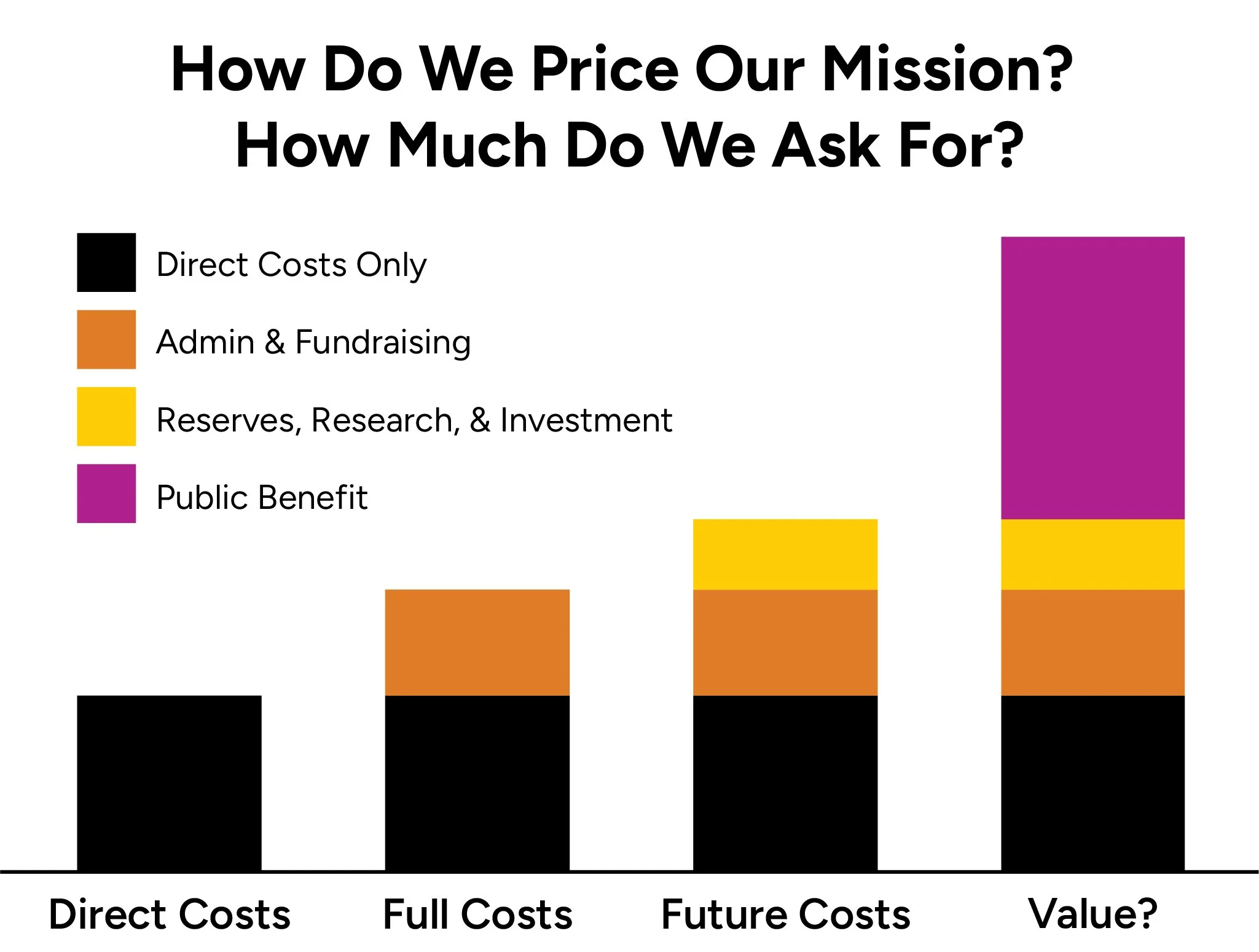
Starting with true program costs as the base, the next step in evolving our thinking is to conceptualize and communicate what financial resources are needed to ensure our organizations thrive, innovate, and succeed amidst daunting challenges. I’ll use a simple bar graph to visualize the next iteration in our collective financial consciousness.
Calling on Ourselves, Philanthropy, and Government to Acknowledge Our True Value
While still imperfect in its adoption, our sector and much of the philanthropic community that supports us have moved from funding only direct costs to more often funding full costs (true program costs). But knowing that running a financial entity at breakeven is a short-sighted and ineffective approach, we should at the very least begin asking our supporters to fund us above our barest costs. To run a surplus financially, we must bring in more resources than we spend. Having a surplus allows us, like any financial entity, to invest in research, innovation, and grow reserves that support operating stability in difficult times and enable us to respond quickly to community crises. As personnel and operating costs spiral upward, we cannot fall behind in our understanding of and communication of what is truly needed for our work to continue.
And where a surplus adequate for funding innovation or reserves would be a vast improvement, our sector has yet to establish its true value as a measure of our financial worth. How can we begin to communicate the immense economic and social benefit that nonprofits produce for communities, counties, states, and our country. Imagine if the public, philanthropy, and/or government shifted to contributing to nonprofits in the same way they happily buy from or contract with for-profit entities for services and goods. Brand, reputation, track record, and proven successes could be earned by nonprofits that instigated real change. Their value to society could become the basis on which their financial value was determined, and their funding could begin to reflect that change in attitude.
One Example of a True Value Budget
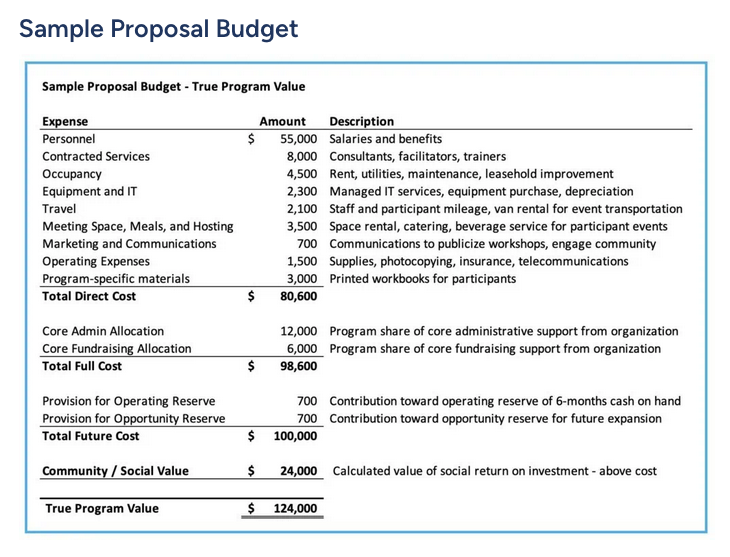
Every revolution requires a first move. In nonprofit finance, one way we can begin to operationalize the concept of true value budgeting is to build bolder budgets. Here is a sample budget that shows the incremental differences between various levels of funding, from direct costs only to true program value. It is up to us to communicate to our supporters what our work is truly worth.
Freeing Our Thinking (and Our Budgets) to Proclaim Our Value
At the ten-year anniversary of “A Graphic Re-visioning of Nonprofit Overhead,” our sector can reflect on progress made in communicating about the true program costs of our amazing work. And at the same time, we can continue to expand our understanding of what strong, solid financial strategies for nonprofits look like. To flourish and be effective in our missions, we must move beyond pricing our organizations and our work at cost. We cannot survive, let alone counter, the many financial, social, and political challenges our organizations are facing if we cannot ourselves expand our understanding of and ways of communicating our value.
Sometimes it is only inertia and old ideas grown too familiar that hold us back. Using true program costs as the starting point, our challenge now is to communicate the need for ample funding for innovation, reserves, and ultimately the true program value of our organizations. I wish us all well as we continue to evolve our understanding of our value as a sector and begin to share that broadly with our supporters.

About the Author - Curtis Klotz, CPA, is a co-founder and member-owner of Diverge Finance Cooperative. Prior to founding Diverge, Curt held roles as Director of Nonprofit Innovation at CLA, VP of Finance & CFO at Propel Nonprofits, and Director of Finance and Administration at Indian Law Resource Center. As a coach, consultant, and presenter, Curt shares innovative business model strategies for nonprofits and a commitment to equity in financial leadership that have emerged from more than 40 years of work in nonprofit organizations. He was a founding board member and past Chairperson of the Montana Nonprofit Association. Curt has contributed articles to Nonprofit Quarterly, National Council of Nonprofits, various CPA journals, and was the creator and principal author of CLA’s Innovation in Nonprofit Finance blog.